Tuscany Property Market: A Complete Regional Guide
No region of Italy captures the international imagination quite like Tuscany. From its rolling vine-covered hills to its Renaissance cities, Tuscany remains the definitive destination for Italian property buyers. Here is everything you need to know.

Why Tuscany Remains a Property Buyer's Paradise
Tuscany has attracted foreign property buyers for decades, and its appeal shows no sign of fading. The region offers a rare convergence of factors: world-class food and wine, a UNESCO-packed cultural heritage, mild Mediterranean climate, excellent international air connections through Florence and Pisa airports, and a property market ranging from affordable rural ruins to multi-million euro estates.
For UK buyers specifically, Tuscany benefits from long-established infrastructure for international purchasers. English-speaking lawyers, estate agents, surveyors, and property managers are readily available throughout the region. Major newspapers and magazines have written about the Tuscan dream for generations, creating a cultural familiarity that makes the buying process feel less foreign than in many other Italian regions.
The Tuscan property market is also notable for its stability. While other Italian regions have experienced significant price volatility, prime Tuscan property—particularly in the Chianti Classico wine country, the Val d'Orcia, and the area around Siena—has maintained its value through economic cycles. Premium properties in these areas are genuinely scarce and rarely discounted, even in softer markets.
Key Areas Within Tuscany
Tuscany is a large and diverse region. Understanding its sub-areas is critical to making the right location choice for your lifestyle and budget.
Chianti and the Florentine Hills – The area between Florence and Siena, known as Chianti Classico, is among the most prestigious property markets in Italy. Rolling vine-covered hillsides, medieval villages, centuries-old estates, and proximity to Florence airport make this area perennially sought-after. Expect to pay a premium: a well-renovated farmhouse (casale) with pool in Chianti starts at around €600,000 and can exceed several million euros for larger estates.
Siena and the Crete Senesi – South of Siena, the Crete Senesi landscape—characterised by smooth clay hills, isolated farmhouses, and cypress-lined roads—is among the most photographed in Italy. Property here is typically less expensive than Chianti while offering equally stunning scenery. A renovated stone farmhouse in the Crete Senesi typically sells for between €350,000 and €900,000.
Val d'Orcia – A UNESCO World Heritage landscape, the Val d'Orcia offers arguably the most dramatic scenery in all of Italy. Properties here are scarce and hotly contested; well-renovated farmhouses rarely come to market below €600,000. The area around Pienza, Montalcino, and Montepulciano is particularly desirable.
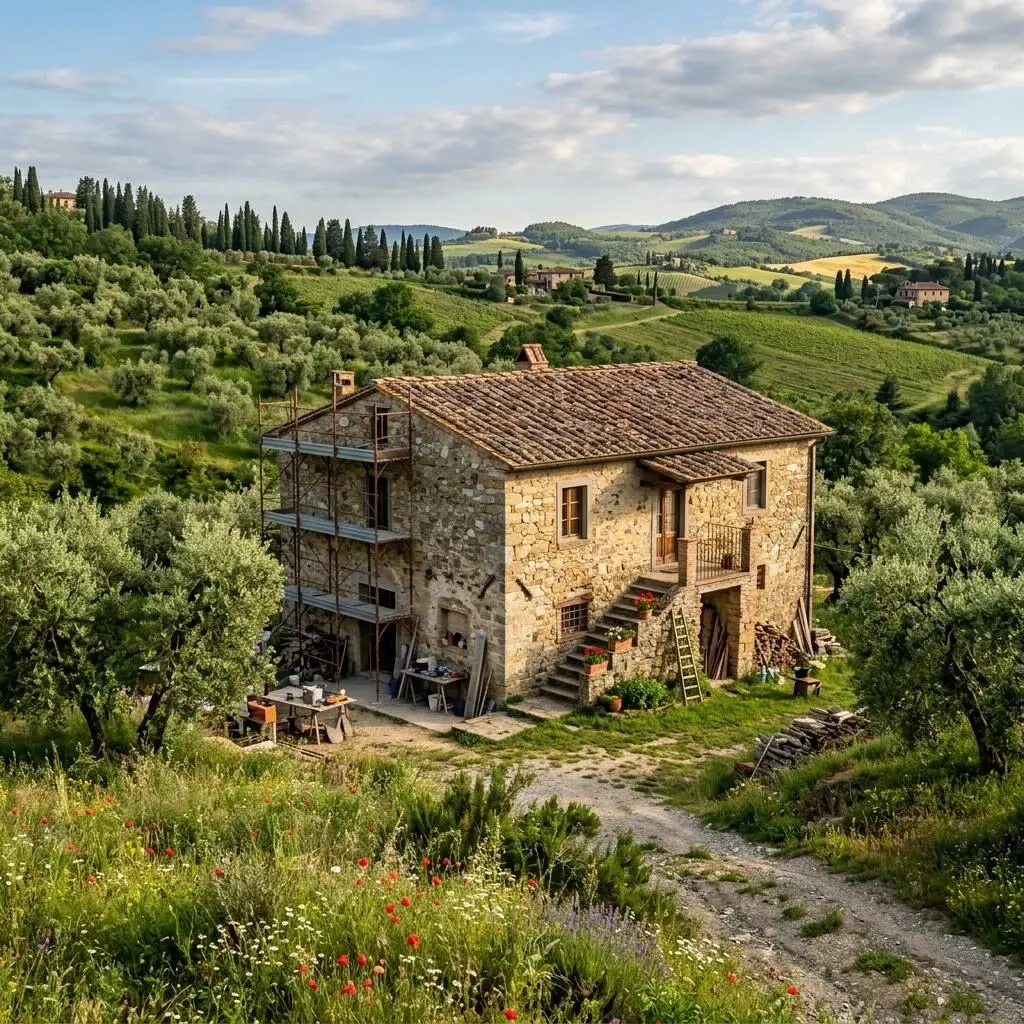
Rural Tuscan stone farmhouses (casali) represent some of Italy's most coveted renovation opportunities.
Lucca and the Versilian Coast – The walled city of Lucca, in northwest Tuscany, offers a more accessible market than the classic Chianti or Val d'Orcia areas. City centre apartments and townhouses are popular with buyers who want urban convenience alongside Tuscan culture. The Versilian coast nearby—Forte dei Marmi, Viareggio—is Italy's most prestigious beach resort area, with prices reflecting its exclusive clientele.
Maremma and Southern Tuscany – Often overlooked by buyers focused on the classic Tuscan heartland, the Maremma in southern Tuscany offers genuine value. Wild coastlines, nature reserves, ancient Etruscan towns, and dramatically lower prices than Chianti characterise this area. It is one of Italy's most underrated property markets and increasingly sought-after by buyers priced out of more famous Tuscan locations.
Property Types Available in Tuscany
Tuscany offers an exceptionally wide range of property types, from modest rural cottages (rustici) to vast agricultural estates (poderi and fattorie). The most sought-after property type is the casale—a traditional Tuscan stone farmhouse, typically with land, outbuildings, and in many cases a swimming pool. These properties vary enormously in condition, from beautifully restored to requiring complete renovation.
City centre properties—apartments and palazzi in Florence, Siena, Lucca, and Arezzo—offer a very different lifestyle proposition: cultural immersion, walkable amenities, and strong rental demand. A two-bedroom apartment in central Florence typically sells for between €400,000 and €1.2 million depending on floor, condition, and precise location.
Renovation projects—particularly properties with original features such as exposed stone, terracotta floors, wooden beams, and bread ovens—command strong buyer interest but require careful evaluation. Italy's permitting system (see our renovation guide below) adds time and cost to any rural building project, and budgeting conservatively is essential.
Tuscany Property Prices: What to Budget
Tuscan property prices span an enormous range. As a general guide, the following price brackets apply at time of writing, though specific properties and locations vary significantly:
- Rural ruin or unrenovated farmhouse: €80,000–€250,000 (depending on size and location)
- Partly renovated country house: €200,000–€450,000
- Fully renovated casale with pool: €450,000–€1,200,000
- Premium estate or historic villa: €1,200,000–€10,000,000+
- City apartment (Florence centre): €5,000–€10,000 per sq m
- Smaller Tuscan town apartment: €1,500–€4,000 per sq m
Rental Potential and Investment in Tuscany
Tuscany's tourism economy is one of the strongest in Italy. Florence alone attracts over 15 million visitors annually, while the Chianti countryside, Val d'Orcia, and Siena draw millions more. For property investors, this translates into strong holiday rental demand for the right type of property in the right location.
A well-presented casale with pool in Chianti or the Val d'Orcia can generate €3,000–€8,000 per week in peak summer season and strong occupancy in spring and autumn. Florence city centre apartments benefit from year-round tourist demand; a well-located two-bedroom apartment can generate €40,000–€80,000 gross rental income annually on a short-let basis.
To find your ideal property for sale in Tuscany, browse our current selection or contact our team for tailored recommendations. For guidance on the purchase process, read our complete guide to buying property in Italy.
Getting to Tuscany from the UK
Tuscany is well served by air from the UK. Florence Airport (Amerigo Vespucci) receives direct flights from multiple UK airports including London Heathrow, London Gatwick, Manchester, and Edinburgh. Pisa International Airport (Galileo Galilei) offers additional routes and is around 80 kilometres from Florence by road. Rome Fiumicino is also a viable arrival point for southern Tuscany, with high-speed rail connections to Florence in under two hours.
Journey times from Florence city centre to the Chianti countryside are typically 30–60 minutes by car. For more remote Tuscan locations—Val d'Orcia, Maremma, the Apuan Alps—a car is essential, and rental car infrastructure is excellent at all three airports.