Italy: A Complete Property Area Guide for UK Buyers
Italy offers one of the most diverse and rewarding property markets in Europe. From Alpine lakes and Renaissance cities to sun-drenched coastlines and ancient hill towns, every corner of the country presents a different lifestyle — and a different investment opportunity. This guide introduces the major regions, what you can expect to pay, and how to decide which part of Italy is right for you.

Why UK Buyers Choose Italy
Italy has been one of the most consistently popular destinations for UK property buyers for decades, and for good reason. The combination of extraordinary natural beauty, world-renowned cuisine and wine, deep cultural heritage, and a genuinely affordable property market — particularly outside the major cities — makes it compelling in a way that few other countries can match.
For UK buyers, Italy holds an additional appeal: it is broadly familiar. Generations of British holidaymakers have visited, and many have never quite shaken the idea of owning a piece of it. Flight connections are excellent, with direct routes from London, Manchester, Birmingham and Edinburgh to Rome, Milan, Florence, Naples, Palermo, Catania and many smaller regional airports. Travel times of two to two-and-a-half hours from most UK cities mean a weekend retreat is perfectly realistic.
The property market itself spans an enormous range. At the affordable end, rural properties in southern regions like Calabria, Basilicata and Molise can be purchased for remarkably low sums — with renovation costs often representing the larger part of the investment. At the premium end, Tuscan estates, Amalfi Coast villas and Lake Como palazzi attract international buyers prepared to spend several million euros for genuinely exceptional properties. Between these two poles lies a rich mid-market of charming townhouses, restored farmhouses, coastal apartments and countryside villas that represent the core of the UK buyer's interest.
Post-Brexit, British nationals buying in Italy are treated as non-EU citizens, which means slightly different bureaucratic requirements — most importantly, obtaining a codice fiscale (Italian tax identification number) before completing a purchase, and declaring funds through standard international transfer channels. None of these represent significant barriers to purchase, but they do underline the importance of working with an experienced English-speaking solicitor and a reputable local agent. Read our complete guide to buying property in Italy for a full walkthrough of the purchase process.
Tuscany: The Classic Choice
Tuscany is the region most immediately associated with the Italian property dream in the UK imagination, and it more than lives up to its reputation. Stretching from the Apennine mountains in the north to the Maremma coast in the south, and encompassing Renaissance cities, ancient Etruscan hill towns, world-famous wine estates and some of the most celebrated countryside landscapes on earth, Tuscany offers extraordinary variety within a single region.
The Chianti Classico belt between Florence and Siena is the most internationally sought-after area, and prices reflect this. A restored stone farmhouse — the classic casale — with several bedrooms, a pool and a hectare or two of olive grove will typically cost between €600,000 and €1.5 million depending on condition, position and proximity to amenities. The Val d'Orcia, designated a UNESCO World Heritage Landscape, commands similar premiums. Smaller, more affordable pockets exist in the Garfagnana (the rugged northern Apennines), the Lunigiana borderlands with Liguria, and the inland Maremma, where prices can be 30–50% below comparable Chianti properties.
Florence and Siena offer strong urban apartment markets, with Florence in particular sustaining excellent rental yields from the enormous international tourist and student population. A two-bedroom apartment in the historic centre of Florence would typically require €400,000–€700,000; in Siena, comparable properties trade at a modest discount.
Tuscany is also the region with the most developed infrastructure for international buyers: English-speaking geometri (surveyors), lawyers and property managers are abundant, and the mechanics of the purchase process are well understood.
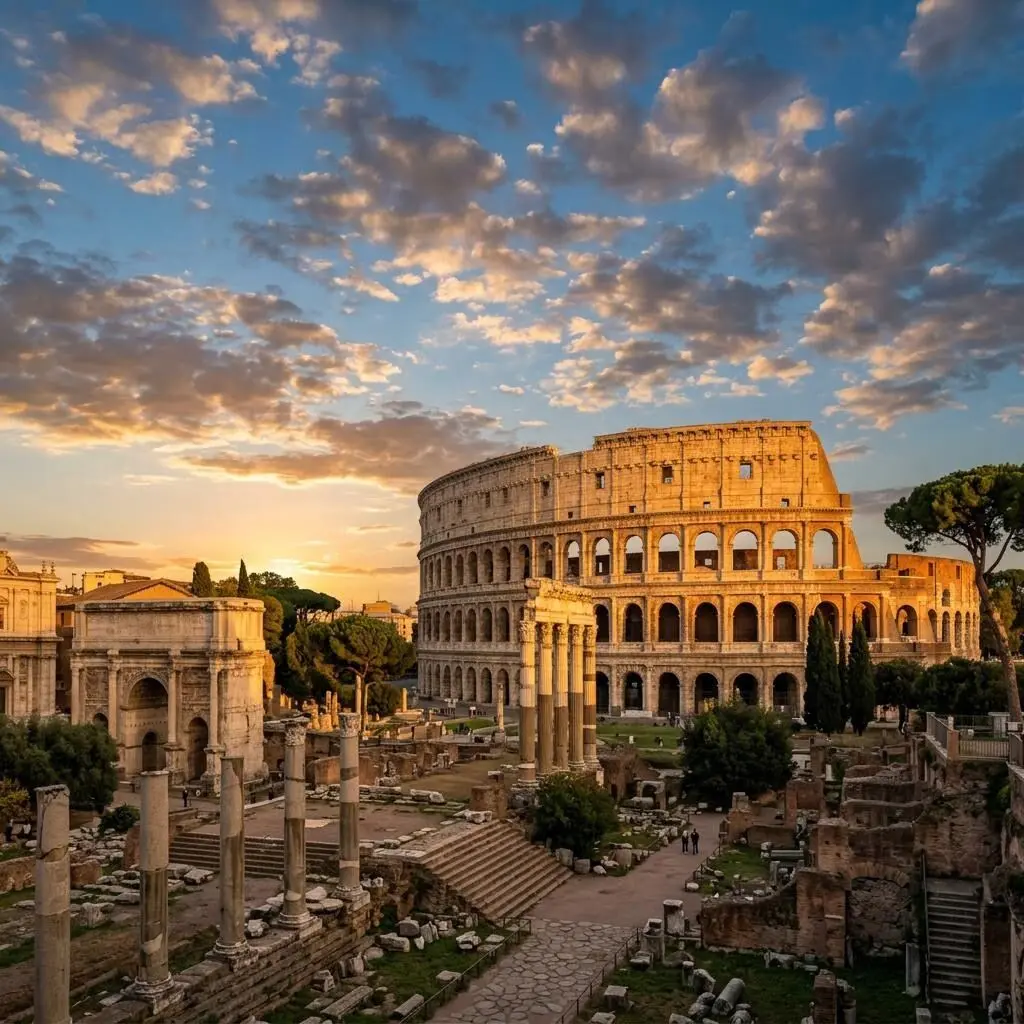
Rome: the Eternal City draws buyers seeking city apartments with strong rental income and cultural capital.
Rome and Lazio: History as a Home
Rome is unlike any other city in the world, and owning an apartment here carries a resonance that transcends pure investment logic. The Eternal City is a living museum — walking its streets, you pass two-thousand-year-old temples, baroque fountains and Renaissance palazzos as part of everyday life. For UK buyers who want a city pied-à-terre with maximum cultural capital, Rome is the obvious choice.
The property market in Rome's historic centre is strong and relatively liquid, underpinned by a colossal and year-round tourist economy — Rome receives over 30 million visitors annually — as well as a large diplomatic and institutional community, international students, and a sophisticated local population. Entry-level one-bedroom apartments in desirable neighbourhoods such as Trastevere, Prati, Parioli and the Centro Storico start at around €350,000–€450,000; larger properties in landmark buildings can command millions.
Beyond the capital, Lazio offers some attractive secondary markets. The Castelli Romani (the Alban Hills southeast of Rome) provide an affordable countryside alternative within 30 minutes of the city, popular with expats seeking a quieter lifestyle without sacrificing urban access. Lake Bolsena and Lake Bracciano in northern Lazio offer lakeside properties at a fraction of the cost of Lake Como, while the Sabine Hills north-east of Rome have seen growing interest from buyers priced out of Tuscany.
The Amalfi Coast and Campania: Spectacular but Selective
The Amalfi Coast is among the most dramatic coastal landscapes in the world — a UNESCO World Heritage Site of vertiginous cliffs, jewel-coloured sea and pastel-painted villages that tumble down to tiny harbours. Positano, Ravello, Amalfi town and Praiano have an almost mythological status in the international property world, and availability of property here is genuinely scarce: the geography constrains development absolutely, and existing properties rarely come to market.
This scarcity means prices are extraordinary. Even modest apartments in Positano can exceed €1 million; larger sea-view properties in prime positions command €3–5 million and beyond. For buyers whose budget does not reach these levels, the Sorrentine Peninsula — the western flank facing the Bay of Naples — offers similar views and lifestyle at somewhat lower price points, and the island of Ischia provides an accessible alternative to the better-known (and more expensive) Capri.
The wider Campania region, with Naples at its centre, is increasingly attracting attention from adventurous buyers. Naples itself has undergone significant regeneration over the past decade and offers some of the most affordable city-centre apartment prices of any major Italian urban centre — though buyers should conduct thorough due diligence and work with an experienced local solicitor, as the property market can be complex. The Cilento coast south of Salerno remains one of Italy's best-kept secrets: a largely unspoilt stretch of beaches and headlands with property prices a fraction of those on the Amalfi Coast.
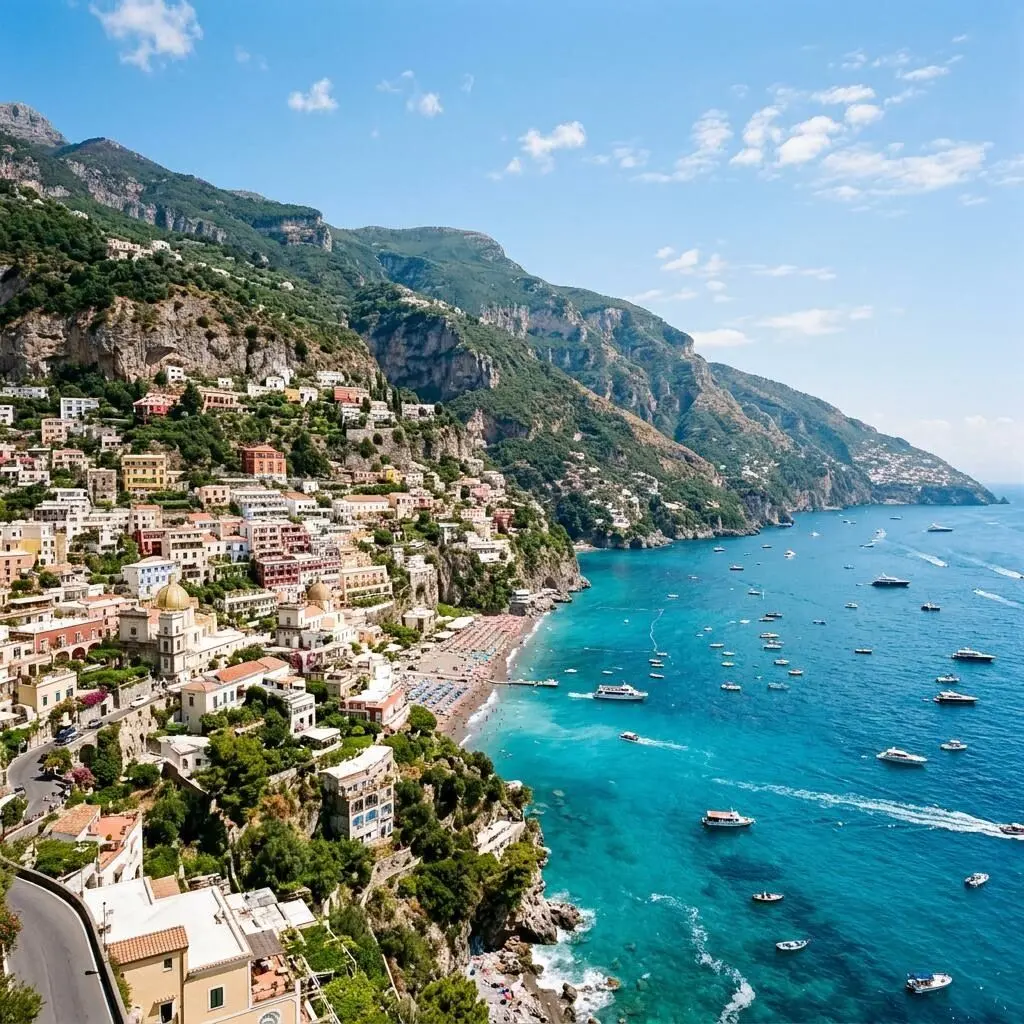
The Amalfi Coast: one of the world's great coastal landscapes, where genuine scarcity keeps prices among Italy's highest.
Lake Como, Lake Garda and the Italian Lakes
The Italian Lakes — Como, Garda, Maggiore and Lugano — represent a distinct property market with its own character and clientele. Protected from cold northern air by the Alps, the lake districts enjoy an almost Mediterranean microclimate while remaining within easy reach of Milan, Zurich and Munich, making them exceptionally popular with northern European and international buyers seeking a blend of mountain and water landscapes.
Lake Como is the most prestigious of the lakes, its dramatic deep-water fjord landscape lined with Belle Époque villas, private gardens and small historic towns. The western shore (the Tremezzina, including Bellagio, Tremezzo and Varenna) is the most sought-after stretch, where restored lakeside villas with private jetties and manicured gardens command prices from €2 million to well over €10 million for landmark properties. More accessible apartments and smaller villas on the eastern shore or in hilltop villages above the water offer entry points from around €300,000–€500,000.
Lake Garda, Europe's largest lake, is broader in its appeal. The northern end (Riva del Garda, Limone, Malcesine) is more rugged and dramatic, popular with watersports enthusiasts; the southern shores around Desenzano and Sirmione are lower-lying and more easily accessible from Milan and Verona. Property prices across Garda are generally 30–50% lower than equivalent Como properties, making it an attractive alternative for buyers seeking lakes lifestyle at a more accessible price point.
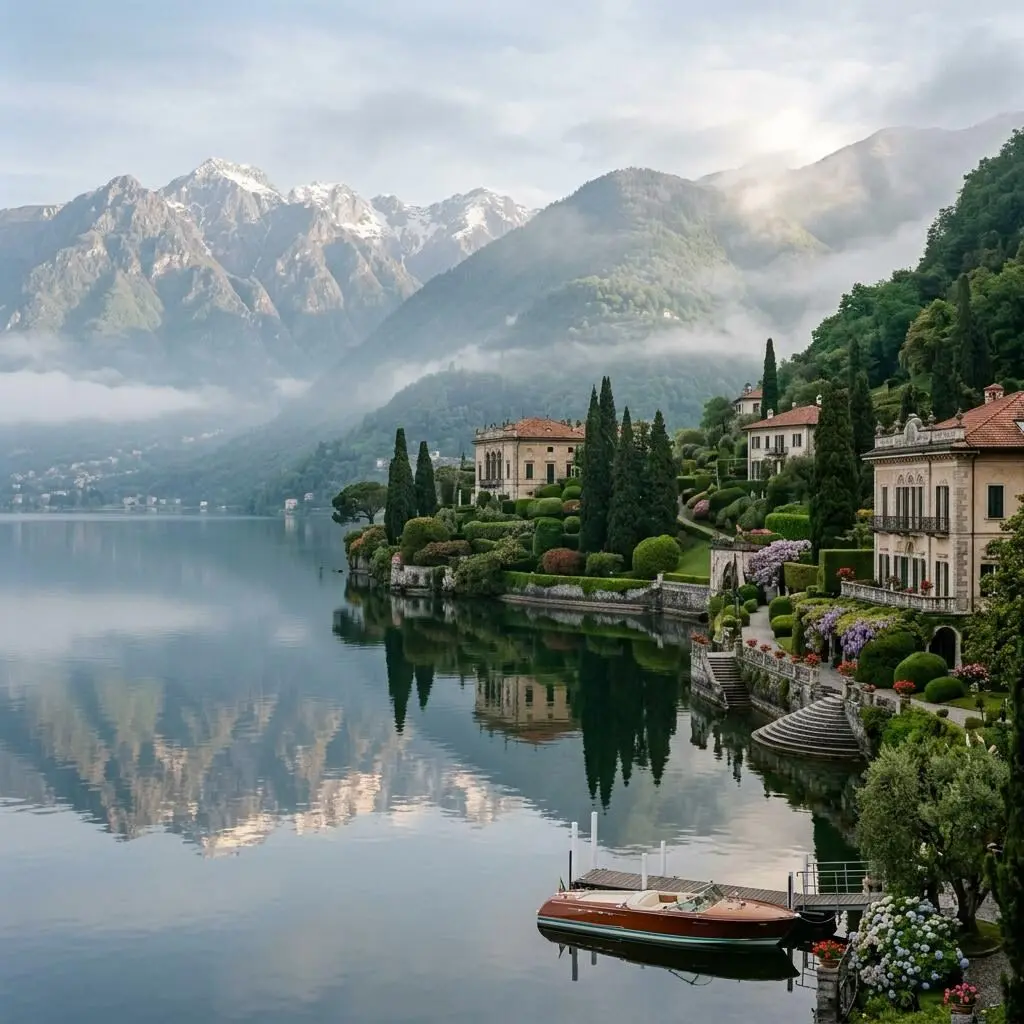
Lake Como: the most prestigious of Italy's lake districts, with prices reflecting genuine scarcity of prime waterside property.
Puglia: Italy's Value Destination
No region of Italy has attracted more attention from UK buyers over the past decade than Puglia, the long heel of Italy's boot. Its combination of genuinely affordable property prices, extraordinary local cuisine, long hot summers, excellent direct flights from the UK (to Bari and Brindisi), and one of the most distinctive architectural traditions in Europe — the famous trulli, whitewashed dry-stone cone-roofed buildings — has made it a firm favourite.
The Valle d'Itria, the green inland valley around Alberobello, Locorotondo, Cisternino and Ostuni, is the heartland of the trulli market. A two-bedroom trullo complex with a small garden and pool can be purchased for €200,000–€350,000 in good condition — extraordinary value by any comparison with the rest of Italy, let alone with equivalent French or Spanish coastal property. Prices have risen considerably since 2015 as international interest has grown, but Puglia remains one of the most affordable areas of Italy for buyers seeking a holiday home with strong rental potential.
The Salento peninsula at the very tip of the heel has a different character — more flat, more bleached, more Greek in feeling, with iridescent sea in shades of turquoise and emerald that rival the Maldives. Towns like Lecce (the "Florence of the South", an extraordinarily well-preserved baroque city), Gallipoli and Otranto offer charming townhouse apartments at prices that remain far below comparable Tuscan or Ligurian equivalents.
Puglia also benefits from Italy's "1 Euro House" schemes, which have been adopted by several municipalities in the region, offering derelict properties at nominal cost to buyers committing to restoration. While these require careful due diligence and a realistic renovation budget, they represent a unique entry point for buyers with vision and patience.
Umbria, Le Marche and the Hidden Interior
Umbria — often described as "the green heart of Italy" — is Tuscany's quieter, less celebrated neighbour, and many property specialists consider it to offer better value than its more famous rival. Sharing many of the same characteristics — rolling hills, medieval hilltop towns, olive groves, excellent wines — Umbria commands prices that typically sit 20–35% below Tuscany for comparable properties. Perugia, Orvieto, Assisi and Spoleto are among the most beautiful towns in Italy; the Lake Trasimeno area offers a lakeside lifestyle at remarkable affordability.
Le Marche, on the Adriatic coast, is another region that consistently punches above its weight in terms of quality-to-price ratio. It combines a beautiful stretch of clean Adriatic coastline with gentle rolling hills in the interior — the Macerata and Fermo provinces in particular are dotted with charming farmhouses and medieval villages at prices that represent genuinely exceptional value. Ascoli Piceno in the south of the region is considered by many to be one of the most beautiful towns in Italy that most visitors have never heard of.
Further south, Basilicata and Calabria represent Italy's true frontier for adventurous buyers. These regions have the lowest property prices in the country — and some of the most dramatic landscapes, including the extraordinary cave city of Matera (European Capital of Culture 2019) in Basilicata and the Calabrian mountains and Tyrrhenian Coast. The infrastructure for international buyers is less developed here than in Tuscany or Puglia, making good legal advice even more important.
Sicily: Europe's Largest Mediterranean Island
Sicily has long been on the radar of UK property buyers, and for good reason: it is an island of extraordinary richness — culturally, gastronomically and historically. The largest island in the Mediterranean boasts a landscape that encompasses the dramatic Aeolian Islands chain, the Greek temples of the Valley of the Temples at Agrigento, the baroque splendour of the Val di Noto, and the perpetually smoking cone of Mount Etna. Palermo and Catania both have direct flights from the UK.
Property prices vary considerably across the island. The coastal towns of Taormina (in the east, overlooking Etna and the sea) and Cefalù (on the northern coast) attract the highest prices, particularly for sea-view properties and historic apartments. The Val di Noto in the southeast — encompassing Noto, Modica, Ragusa and Scicli, all baroque UNESCO towns — has emerged as a sophisticated buyer's destination offering extraordinary architecture at relatively accessible prices. Rural farmhouses and masserie (fortified farmhouses) in the interior can be purchased very affordably, though renovation costs must always be factored carefully.
Sicily has enthusiastically adopted 1 Euro House schemes, with numerous municipalities offering nominal-price properties to buyers prepared to restore them, sometimes with €25,000 renovation grants attached.
Choosing Your Region: Key Questions to Ask
With such richness and variety, the challenge for UK buyers is not whether to buy in Italy, but where. A few key questions help to narrow the choice:
- How often will you use it? If you plan frequent short trips, proximity to a direct-flight airport becomes paramount — Tuscany, Rome, Puglia, Sicily and the Lakes all score well here. More remote regions may offer better value but require longer journeys.
- Holiday let income or capital growth? If rental yield matters, well-known tourist destinations with year-round appeal (Florence, Rome, Amalfi, Puglia) outperform remote rural properties. If you are buying primarily for personal use and long-term capital appreciation, prime Tuscany, Lake Como and Rome have the most consistent track records.
- Renovation or move-in ready? Italy's diverse stock includes everything from fully-restored luxury estates to uninhabited ruins. Budget for renovation realistically — Italian building projects have a well-deserved reputation for complexity and cost overrun. Read our practical guide to renovating property in Italy before committing to a project.
- Climate preferences? Northern Italy (the Lakes, Piedmont, Alto Adige) has a more continental climate with cold winters. Central Italy (Tuscany, Umbria, Le Marche) is temperate and four-seasonal. The south and Sicily are genuinely hot and dry in summer, with mild winters — ideal if long summers are the priority.
- Budget? Italy's wide range means budgets from £150,000 (for a small rural property requiring work in the south) to many millions can all find a foothold. Decide early whether renovation costs are within appetite, as they significantly extend what your budget can achieve.
Working with a Specialist Agent
Unlike the UK, Italy does not have a single centralised property listing system, and the market operates very differently in different regions. Local agents (agenzie immobiliari) often hold exclusive or semi-exclusive access to properties that are not marketed nationally or internationally. A UK-facing specialist with established relationships across Italy can give buyers access to properties that simply would not be visible through online portals — and critically, can provide the local knowledge, due diligence support and transaction management that makes a complex international purchase run smoothly.
The Italian buying process involves several stages not familiar to UK buyers — the proposta di acquisto (offer to purchase), the compromesso (binding exchange contract), the independent notaio who acts for both parties, and the final atto notarile (completion deed). Each stage requires careful legal advice. Buying costs including taxes, notary fees and agent commissions typically add 10–15% to the purchase price, depending on buyer status and property type — budgeting for these from the outset is essential.
Italy rewards thorough preparation and punishes haste. The buyers who enjoy the best outcomes are those who research their preferred region properly, visit multiple times in different seasons, take independent legal advice, and work with professionals who know the local market well. With those foundations in place, Italy remains one of the most rewarding property markets in the world.
Ready to Explore Italian Property?
Browse our current listings across Italy's most desirable regions, or get in touch to discuss your requirements with our team.